
DESIGN STORIES: Circe’s Garden
I first visited Mount Stewart nearly ten years ago. As soon as I walked into the garden on that warm damp day in May I was completely captivated by its charm. We had travelled to Northern Ireland for the wedding of a friend but, as my grandmother’s family are from there, we stayed an extra few days to explore, driving up to the Giant’s Causeway and then south, to County Down, where we stayed in a wonderful little Georgian B&B, Edenvale House (sadly no longer operating as such) on Strangford Lough visiting Castle Ward, which I would also recommend, and Mount Stewart.
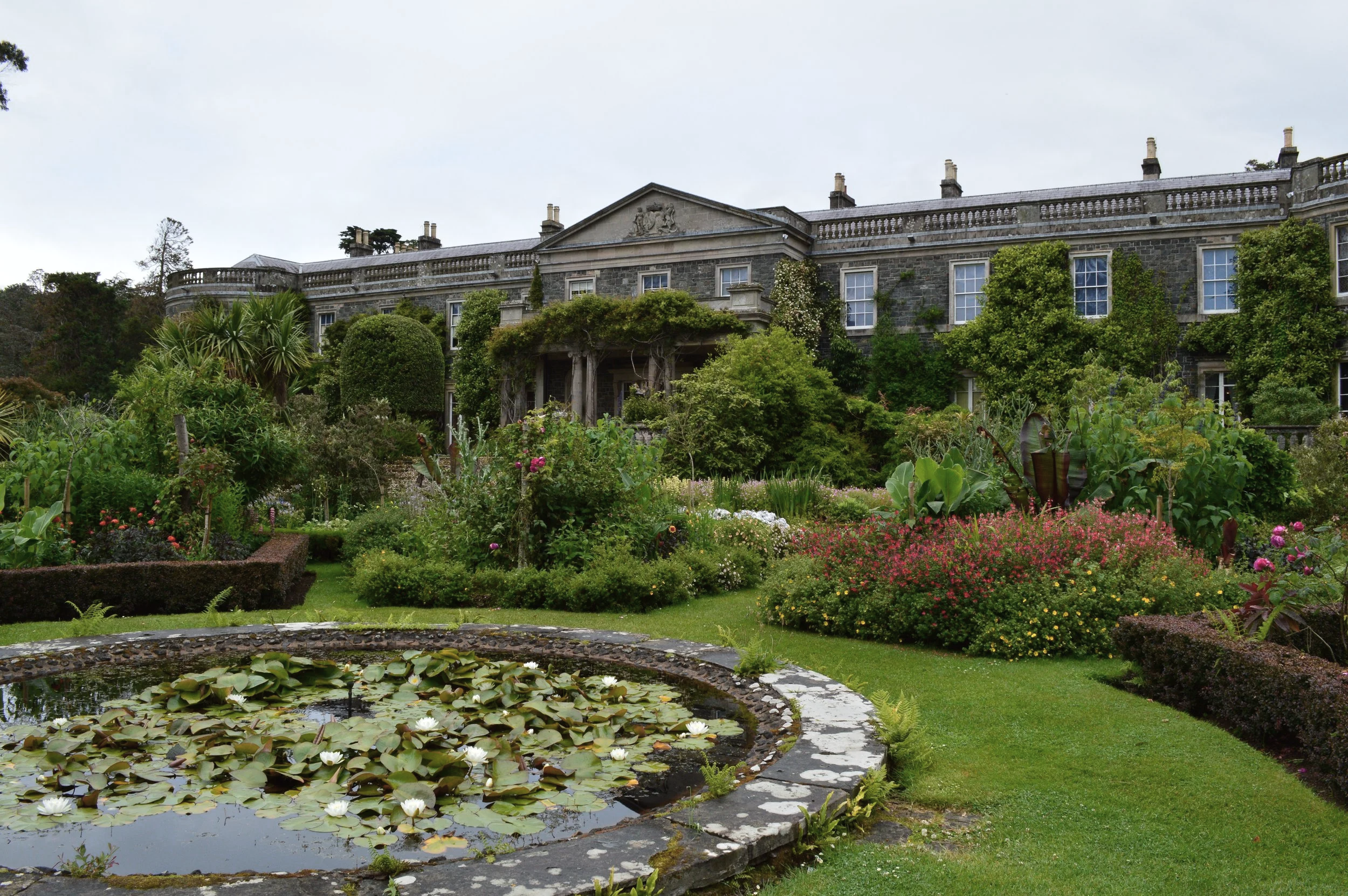
Mount Stewart and its gardens. Photo: Fanny Shorter
Mount Stewart sits on the east shore of Strangford Lough. It is the ancestral home of the Stewart family (now owned by the National Trust) and was developed from a relatively modest house in the mid 19th century to how it looks today, with its impressive portico and balustrade entrance. The gardens were largely the work of Edith, wife of Charles, the 7th Marquess in the early part of the 20th Century and it was the gardens we were there for. Taking the opportunity the good weather provided and still feeling the effects of the party the night before, we skirted the house and walked up to the lake, taking in the fresh air and sunshine. We admired the enormity of the gunnera leaves and the prolifically successful cygnet nursery before meandering back on wide grass paths through the shrubbery to the café, sharing a bowl of chilli and then, sufficiently restored, on, into the house.

Left: A marble statue of a bacchante in Central Hall and right: the West Stairs and the George Stubbs painting, ‘Hambletonian, Rubbing Down’
The double height octagonal Central Hall, as the name would imply, sits in the middle of the house. The floor is a beautifully restored, light sandstone, perfectly complemented by deep green scagliola pillars that flank the walls and lit from above via a huge octagonal lantern skylight mirroring the floor plan below. A number of life size classical marbles are displayed in the hall among them the huntsman Adonis, Apollo, Venus after a bath and Narcissus admiring himself. Surrounding the hall, the dining room, drawing room and sitting rooms boast delightful, coloured coving, more scagliola columns and repeating architectural motifs in the cornicing and inlaid floors. The many views onto the garden offer a damp green taster of the outside. It is completely charming and one of those houses that truly feels personal as well as impressive.
As you climb the West Stairs from the hallway, painted a vivid arsenic green, you are met with a huge George Stubbs painting, Hambletonian, Rubbing Down before the staircase divides and continues up to the bedrooms. Doing the job I do, I am always keen to get to the bedrooms (or, in fact, anywhere fabric and wallpaper do the talking) and I’m there for it all, the truly antique to the 50s chintz. Not many of the bedrooms were open but from the few that were, the bold wall colours, damask upholstery and a particularly beautiful paper bed hanging (which has now been restored) ticked all my boxes.

Left: Me on a wall with an urn and some wisteria. Bottom left: The Dodo Terrace and Ark. Right: The herm pillars, all created by Thomas Beattie c. 1930
Mount Stewart’s proximity to the lough, and the buffer of trees along its shore, provides the gardens with a humid climate that feels unusually mild and creates the perfect environment for teeming growth. Being May, the garden was going for it. The camellias were just at an end, giving way to frothy displays of wisteria, clematis and azaleas all to a backdrop of soaring rhododendrons. As you walk out onto the lawn you notice animals and mythical beasts sitting among the lush foliage or atop a gatepost. A cheetah and a horse lie along the top of a wall, there’s a wild boar and a mermaid in the bushes, a dove, a dog, a griffin, a baboon, a hare, even an ark flanked by a rotund pair of dodos and, the icing on the crazy-cake: running parallel to the house, a procession of herm pillars holding orangutans, holding pots, sitting on men’s heads with bunch-of-grapes-earrings that, pillar by pillar, morph into pigs with dangling trotters.
These were also the product of Edith’s imagination. While, clearly, a devoted and avid gardening enthusiast and exuberant plant collector, ordering many species from abroad and sponsoring plant-hunters including Frank Kingdon-Ward, Edith was also a socialite and an important figure during WWI, creating the women’s legion and (explanation incoming) the ‘Ark Club’ a weekly social gathering whose members included politicians (Churchill and Chamberlain among them), writers (such as JM Barrie), poets and artists. It is to this ‘Ark’ that the statues belong.
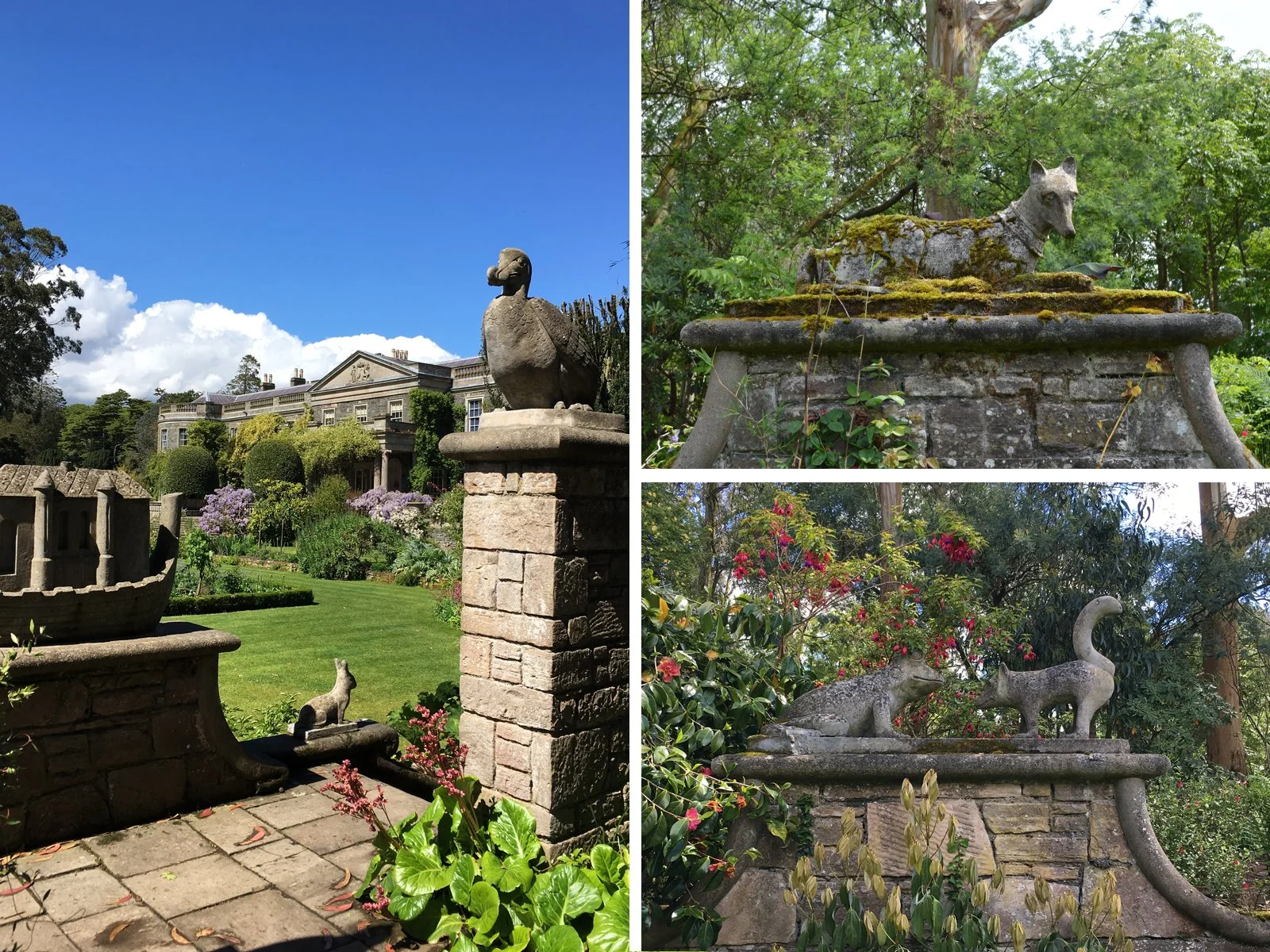
Some of the Thomas Beattie cement animal sculptures in the garden.
Each club member was assigned an animal nickname and alter ego, and it is these creatures that are represented as the cement sculptures (designed by Thomas Beattie) throughout the gardens. Edith’s aging father, Viscount Chaplin is depicted as the Dodo, her philandering husband Charlie, the cheetah. Frederick, Lord Dufferin, Freddie the Frog. Sir Philip Sassoon, secretary to Earl Haig and fellow enthusiastic gardener, the Fox. David Lloyd George was the Griffin. J M Barrie, a bard, Sir Winston Churchill, a warlock, Neville (The Devil) Chamberlain and so on. The aforementioned orangutan pillars illustrate the gradual metamorphosis of Odysseus’s crew into pigs at the hand of Edith herself albeit under the guise of the sorceress Circe. It’s wild and witty and, rather like the house, crammed with its guardian’s personality. I had never been so entertained by a garden.

Left: My original sketch for the design. Right: One of the screens used to sample the wallpapers
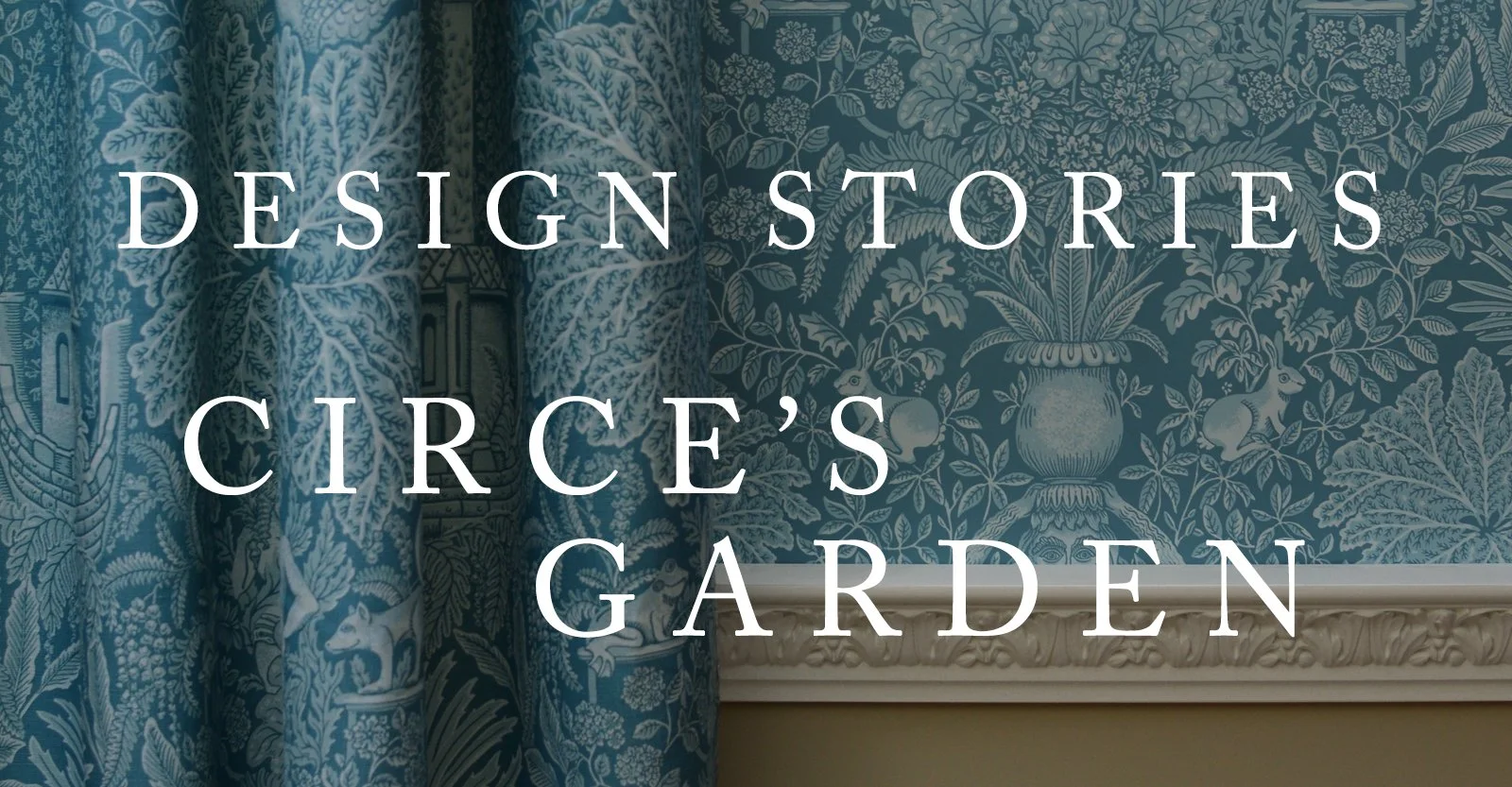
That first visit sowed the seeds (pun-derful, I know) for the design that is Circe’s Garden. I made some initial sketches and then the idea stayed on my desk for an inordinately long time before it made the ultimate leap from drawing board to firm design. The busy-ness of the final drawing persuaded me to keep the palette limited and, in the end, I chose to mimic some of the damasks found in the house, choosing a single hue and varying the shade to create depth but not all out chaos. The Adonis and a bare-bottomed bacchante from Central Hall found their way into the design and they stand, side by side, waste deep in ferns (largely to give them a little more modesty) under a canopy of those umbrella-esque gunnera surrounded by the beasts and plants found throughout the garden. It was meant to be a nod to this particular garden and a homage to the whimsical English garden in general but as this has been so perfectly executed at Mount Stewart the nod and homage may have flipped. We have screen printed the design as a wallpaper in our Leicestershire factory and as a hand-printed upholstery linen at our wonderful London factory. To see these just visit our shop page.

Left: Chris, our printer, at the factory about to print the second colour on a 50m length of linen. Right: Circe’s Garden linen and wallpaper in situ.
To refresh my memory before finalising the design, I made a second visit to Mount Stewart, last year, this time towards the end of June and the garden was at its peak. Foxgloves and delphiniums towered over my head shooting through beds of roses, poppies, alstroemeria and potentilla (to name a few I recognised and, it is only a few, I am no horticulturalist). It was colourful and abundant and playful, like a children’s book garden. My love of the place was renewed and a few months later we started sampling the final prints.
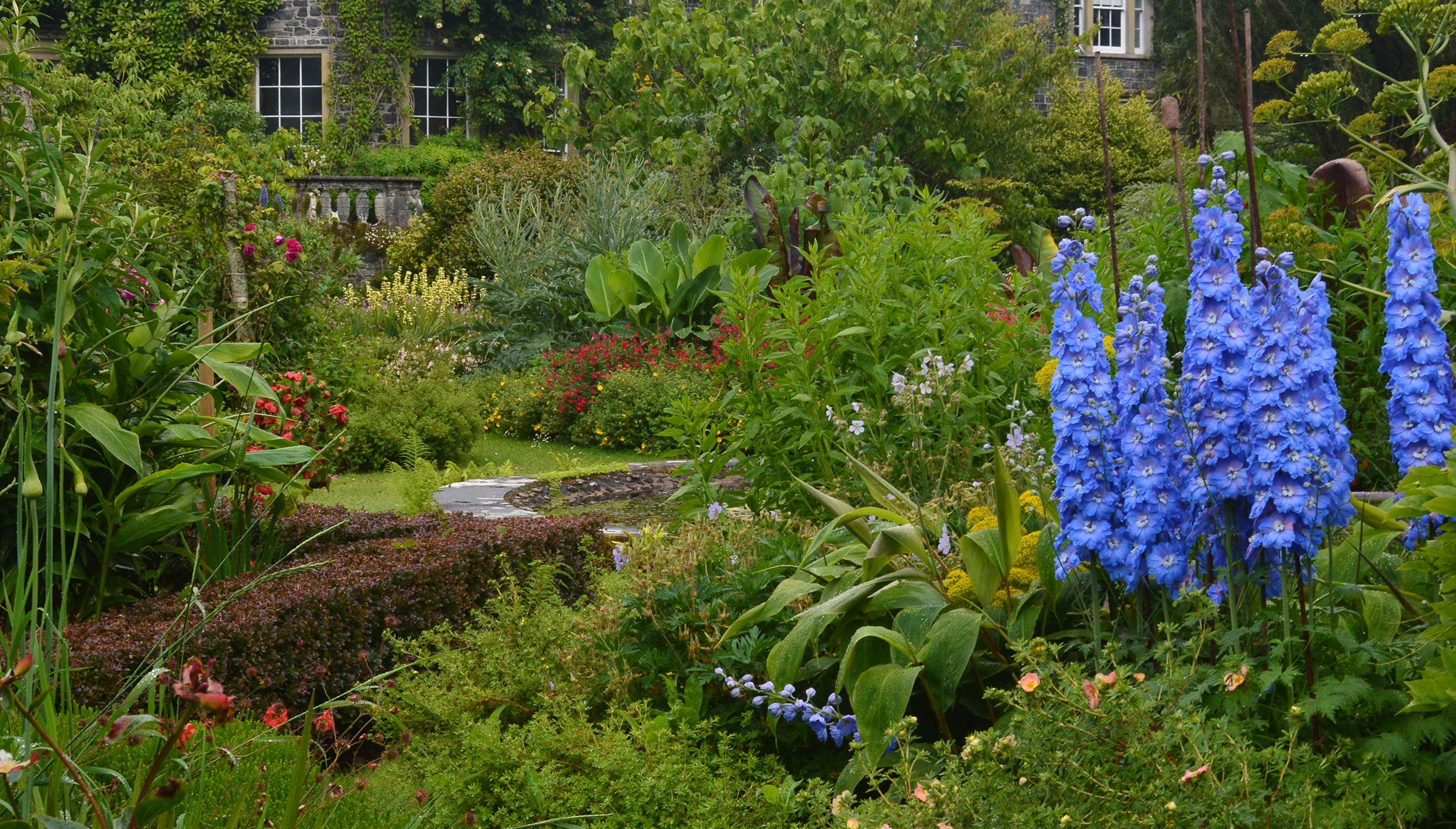
Mount Stewart’s garden in June
A small but delightful footnote to all this, came to me from my cousin who lives in Northern Ireland, and indeed very near Mount Stewart. When I told him about the design, he informed me that, in fact, my great-great-great-great-grandfather John Andrews was land agent to Charles William Vane, 3rd Marquess of Londonderry and oversaw the 1840 remodelling of the house. His wife Sarah Drennan (my 4x great-grandmother) advised with the interiors. Even though this predates the garden by 80 years or so, I am, of course, exceedingly pleased that I have this historical connection to the place and that its magic is ever so slightly more personal to me because of it.
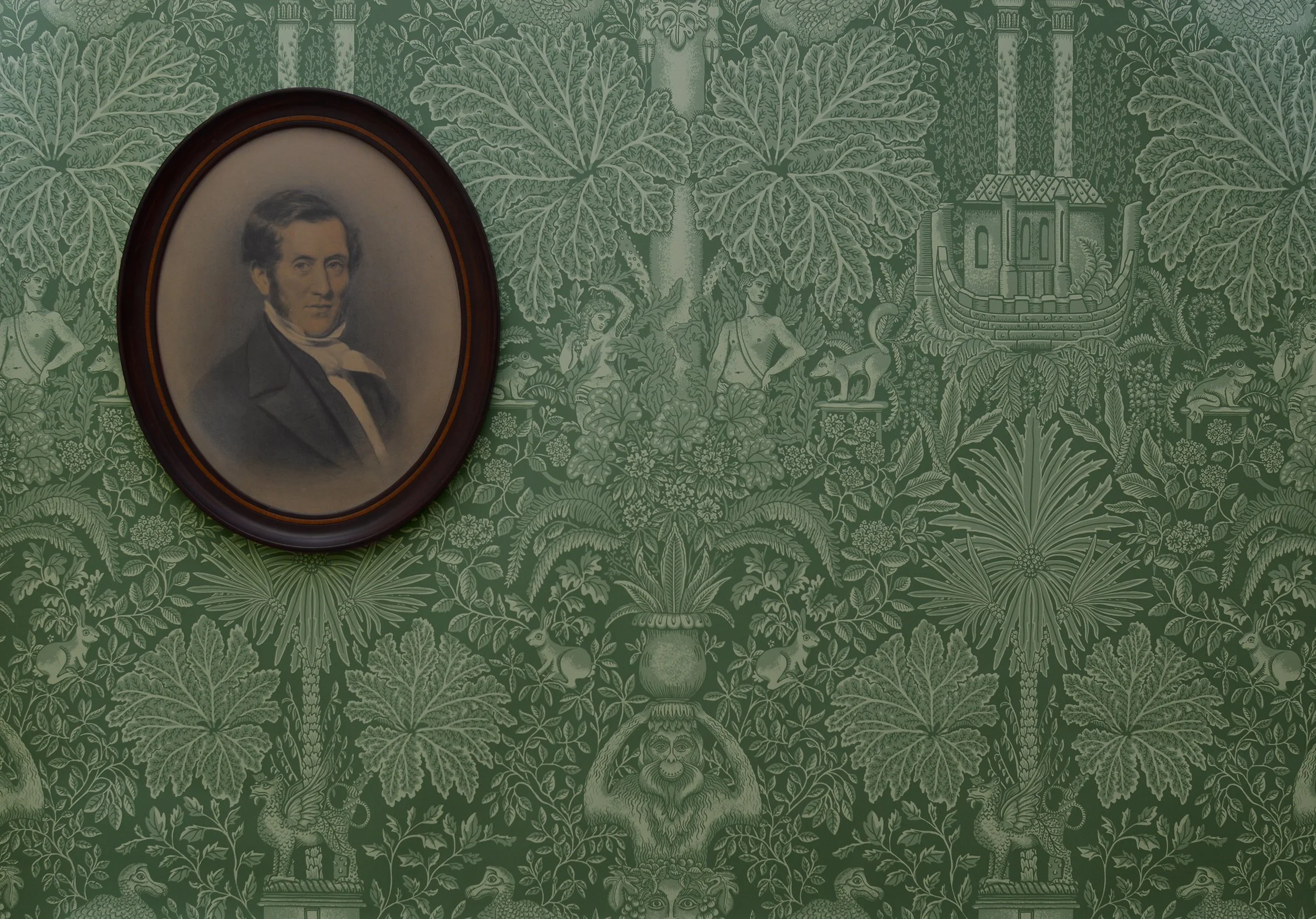
A portrait of my great-great-great-great-grandfather, John Andrews hanging on our Circe’s Garden wallpaper in Fernery